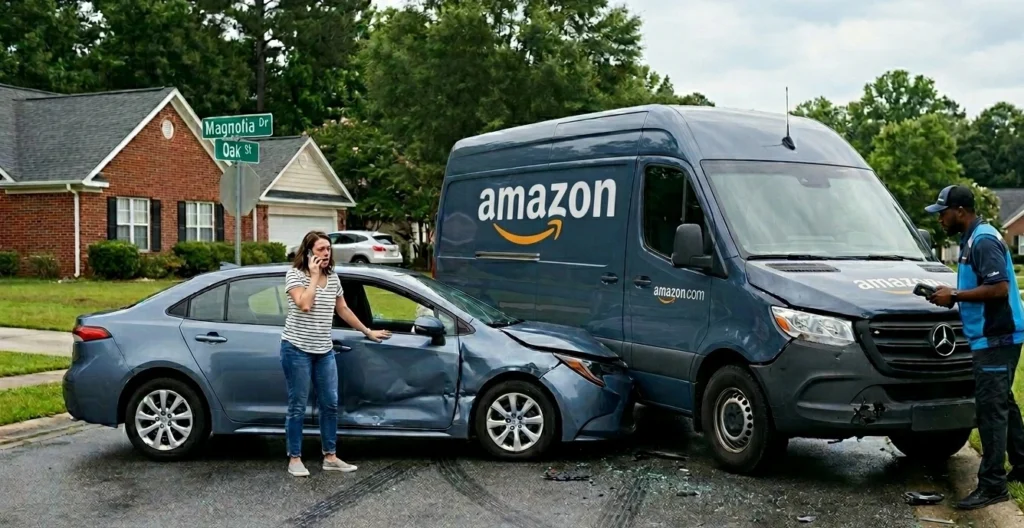
Amazon delivery driver accident cases in South Carolina are complex because Amazon uses DSP contractors while still controlling routes, quotas, and driver behavior through its app, leading to multiple liable parties, layered insurance coverage, and fast-disappearing digital evidence. This guide explains how liability is established, what insurance applies, what evidence must be preserved immediately, and how injured victims can pursue full compensation under South Carolina law.
Amazon Delivery Driver Accident Attorney South Carolina: Why These Cases Are Different
Amazon uses a Delivery Service Partner (DSP) model where independent companies hire drivers and operate Amazon-branded vans. After a crash, Amazon often claims the DSP alone is responsible.
That defense is weakened by Amazon’s control over routes, quotas, safety monitoring, and branding through its app. South Carolina courts focus on actual control, not contract labels. When Amazon directs the work, liability can extend to it.
The Three Defendants in an Amazon Delivery Crash Case
A single Amazon delivery crash in South Carolina can involve multiple liable parties, each with separate insurance coverage. Identifying and pursuing all defendants is key to maximizing compensation.
1. DSP Company (Delivery Service Partner)
- Direct employer of the driver
- Holds vicarious liability for the driver’s actions
- Required by Amazon to carry commercial auto insurance
- Provides an immediate source of coverage from the start of a claim
2. Amazon Logistics Insurance Coverage
- Maintains its own commercial auto insurance program
- Covers DSP drivers during active deliveries
- Policy limits can reach up to $1,000,000 per occurrence
- Applies even though drivers are classified as DSP employees
3. Amazon.com, Inc. (Direct Liability)
Can be held directly liable for its own actions
Examples of contributing factors include:
- Unrealistic delivery quotas that encourage speeding
- Routing systems directing drivers through unsafe areas
- Failure to act on known safety risks or driver violations
Pursuing all three defendants together strengthens the case and increases total recovery potential.
How Amazon’s DSP Model Creates a Liability Shield
Amazon designed the DSP program to create legal separation from delivery driver negligence. By using independent companies instead of hiring drivers, it argues there is no employment relationship with the driver who caused the crash, an argument that has had mixed success in courts.
The weakness in this defense is the degree of control Amazon exercises. Its app dictates routes, stop order, and tracks driving behavior like speed and braking. It assigns safety scores and can require DSPs to remove drivers. When a company controls work this closely, courts increasingly reject the independent contractor label in commercial vehicle cases.
South Carolina Law and How It Applies to Amazon Crashes
South Carolina law provides multiple paths to hold parties accountable in an Amazon delivery crash, especially when control and safety oversight extend beyond the driver.
Vicarious Liability and Amazon’s Role
- South Carolina’s vicarious liability doctrine holds employers responsible for employee negligence while on duty
- Amazon may be held liable beyond the DSP level due to its operational control over drivers
- The legal argument focuses on practical control, not just formal employment status
Control factors may include:
- Delivery schedules and quotas
- Routing systems and logistics oversight
- Performance monitoring and enforcement
Negligent Entrustment Claims
- Applies when a company allows a known unsafe driver to continue operating
- Amazon’s internal safety systems may flag high-risk drivers
- Failure to act on this data can create direct liability
- South Carolina courts recognize liability for knowingly putting dangerous drivers on the road
Critical Evidence and Timing
Amazon’s monitoring systems automatically generate safety and driver data
Key evidence may include:
- Driver performance and safety records
- Incident reports and internal flags
- Route and delivery data
This data can be overwritten quickly without legal action, making immediate legal hold requests essential to preserve key evidence. Acting quickly after a crash is critical to securing the records needed to prove both control and negligence.
South Carolina’s Comparative Negligence Rule in Delivery Accident Cases
South Carolina uses a modified comparative negligence rule. You can recover compensation if you are no more than 50 percent at fault, but your recovery is reduced by your percentage of fault. For example, if you are 20 percent at fault, you recover 80 percent of your damages.
Insurance carriers often use this rule to limit payouts. Adjusters may contact victims soon after a crash, sometimes before legal representation, and ask questions aimed at establishing fault. Anything said can be used to increase your fault percentage and reduce compensation. Refusing a recorded statement until you have an attorney is not obstruction, but a critical step after a crash.
What Injuries Amazon Delivery Van Crashes Produce
Amazon delivery vans typically weigh 10,000 to 15,000 pounds when fully loaded, about three to four times more than a standard passenger car. At neighborhood speeds of 25 to 35 miles per hour, the impact force on a smaller vehicle is far beyond what most safety systems are designed to absorb.
Common injuries in these crashes include traumatic brain injuries from sudden deceleration, spinal fractures and herniated discs, broken bones, internal organ damage, and severe pedestrian injuries when vans strike people near sidewalks or entrances. These injuries often require surgery, long-term treatment, and careful documentation for full compensation claims.
What Compensation You Can Recover in an Amazon Delivery Accident Case
Legal Basis in South Carolina
- South Carolina law allows injured victims to pursue the full range of economic and non-economic damages in delivery driver accident cases.
Economic Damages
- Medical expenses from emergency care, surgery, rehabilitation, and future treatment costs directly related to injuries are recoverable.
- Lost income during recovery and diminished earning capacity when injuries affect future work are included in claims.
Non-Economic Damages
- Pain and suffering, emotional trauma, and loss of quality of life are compensable under South Carolina law.
- There is no damage cap in personal injury cases for these losses.
Punitive Damages
- When conduct involves willful, wanton, or reckless disregard for safety, punitive damages may also apply.
Case Results Example
- Spartan Law recovered $150,000 for full lumbar surgery costs in a commercial vehicle case.
- They also recovered $100,000 for hand and disc surgery costs in similar cases.
- These outcomes were based on documenting the full economic impact of injuries, not just immediate medical bills.
Amazon’s Defense Strategy in Delivery Accident Cases
Amazon and its Delivery Service Partner (DSP) carriers rely on predictable legal defenses in accident claims, and anticipating these tactics allows an attorney to build a strong case from the outset.
Common Defense Tactics
- Independent Contractor Argument: Claims the DSP driver is not an Amazon employee, limiting Amazon’s liability.
- Policy Limit Tactic: Attempts to direct claims toward the DSP’s smaller insurance policy instead of Amazon’s larger coverage.
- Recorded Statement Trap: Involves early contact from insurers requesting statements to establish partial fault.
- Medical Causation Challenge: Questions whether injuries are crash-related or pre-existing.
How an Attorney Counters These Strategies
- Proving Operational Control: Demonstrates Amazon’s influence through apps, safety metrics, quotas, and branding requirements.
- Pursuing Multiple Insurance Policies: Targets both the DSP policy and Amazon’s $1,000,000 coverage layer simultaneously.
- Managing Insurer Communication: Directs all contact through legal counsel to avoid damaging statements.
- Establishing Medical Evidence Early: Secures same-day medical evaluation to link injuries directly to the crash.
Understanding these defense strategies provides a clearer view of how claims are challenged, while also highlighting how experienced attorneys protect clients and maximize recovery in commercial vehicle accident cases.
The Evidence That Makes or Breaks an Amazon Delivery Accident Case
Amazon delivery cases involve evidence not seen in standard car crashes. The delivery app records GPS location, speed, hard braking, and route sequencing for each driver. Amazon’s safety system also tracks driver performance over time, while DSP records show assigned delivery windows and workload pressure.
This data is controlled by Amazon or the DSP and is not automatically preserved after a crash. GPS and app records may be overwritten within days, and safety scores can be altered or deleted. An immediate litigation hold is critical to preserve this evidence before it disappears.
How Thomas Conits Handles Amazon Delivery Accident Cases in South Carolina
Amazon delivery accident cases move quickly on the defense side. Once a crash is reported, Amazon’s insurer deploys adjusters and legal teams immediately to limit payouts. Fast attorney response is essential to protect recovery.
Thomas Conits has been admitted to the South Carolina Bar since 2021 and personally handles Amazon delivery accident cases statewide, including Greenville, Columbia, Charleston, Spartanburg, and Anderson. Speak directly with your attorney, not a case manager or paralegal. This direct access is standard practice at Spartan Law across all commercial vehicle cases.
Statute of Limitations for Amazon Delivery Accident Claims in South Carolina
South Carolina’s personal injury statute of limitations is generally three years from the date of the crash. While this may seem like ample time during recovery, key evidence disappears much sooner.
Amazon app data, driver safety scores, and DSP dispatch records can be lost within 30 to 60 days without a legal hold. Witness memories fade and traffic footage is often overwritten. The filing deadline is three years, but evidence preservation must happen immediately to protect the strength of the claim.
Amazon Delivery Driver Accident Attorney South Carolina – Protecting Your Rights and Recovery
Amazon delivery driver accident cases in South Carolina are complex due to multiple layers of liability, aggressive insurance tactics, and fast-disappearing digital evidence. Although Amazon uses the DSP model to avoid responsibility, South Carolina law focuses on actual operational control, which can extend liability to the DSP, Amazon’s insurance coverage, and Amazon itself. Successful claims depend on identifying all liable parties, preserving app and driver data quickly, and countering insurer strategies designed to reduce compensation. An experienced amazon delivery driver accident attorney south carolina is critical to protect evidence, navigate comparative negligence rules, and pursue full recovery for medical costs, lost income, pain and suffering, and long-term damages.
If an Amazon Driver Hit You in South Carolina, Act Now
Amazon’s liability structure is built to create delay and confusion. Every day without an attorney is a day Amazon’s insurer spends building their side of the case while critical evidence disappears. Thomas Conits at Spartan Law pursues Amazon delivery accident cases across South Carolina with direct attorney access from the first call and no fee unless he wins.
Call 864-777-1000 now or visit the free consultation page to get started.
Frequently Asked Questions
1. Can I sue Amazon directly if one of their delivery drivers hit me in South Carolina?
Yes, in many cases. Liability depends on Amazon’s level of operational control, including its app, routing system, and delivery quotas. Courts focus on the real working relationship, not contract labels. If Amazon directed how the driver worked, liability may extend to Amazon, not just the DSP.
2. What insurance coverage applies to an Amazon delivery driver crash in SC?
Typically three layers apply. The DSP commercial policy is first, followed by Amazon’s up to $1,000,000 commercial coverage during deliveries, and then the driver’s personal policy if gaps remain. Using all layers together helps avoid low settlements.
3. What should I do immediately after being hit by an Amazon delivery driver in SC?
Call 911 and get medical care right away. Photograph the vehicle, Amazon branding, plate, and damage. Do not give recorded statements to insurers before speaking with an attorney. Contact Spartan Law at 864-777-1000 quickly so key delivery data can be preserved.
4. Does it matter that the Amazon driver was using the delivery app when they hit me?
Yes. The app controls routing, GPS tracking, and safety scoring. If the driver was actively following Amazon’s instructions at the time, it strengthens the argument that Amazon had direct operational control, increasing potential liability.
5. What if Amazon’s insurer contacts me before I have an attorney?
Do not provide a recorded statement. Adjusters may ask questions designed to shift fault under South Carolina’s comparative negligence rule. Politely refuse and refer them to your attorney. Early statements can be used to reduce your claim value.
6. What if the DSP company has already denied my claim?
A denial does not end the case. Amazon’s coverage and liability can still be pursued separately. An attorney can use Amazon’s data, routing control, and monitoring systems to build a direct claim. A DSP denial is not the final outcome.
Key Takeaways
- Amazon’s DSP model is designed to create legal distance between Amazon and driver liability, but South Carolina courts examine actual operational control, not contract labels.
- Three insurance coverage layers typically apply: the DSP’s commercial policy, Amazon’s own program with limits up to $1,000,000 per occurrence, and the driver’s personal policy if coverage gaps exist.
- Amazon’s real-time driver monitoring system generates safety scores that become direct evidence of negligent supervision when a flagged driver causes a crash.
- Do not give a recorded statement to Amazon’s insurer before hiring an attorney. That statement is used to push your fault percentage up and your recovery down under SC’s comparative negligence rule.
- Driver monitoring data, delivery sequence logs, and GPS app records require a legal hold within 48 hours of the crash. Without it, Amazon’s systems overwrite the most damaging evidence before litigation begins.
- Thomas Conits handles every Amazon delivery accident case personally across South Carolina, from evidence preservation through final settlement, with no fee unless he wins.