
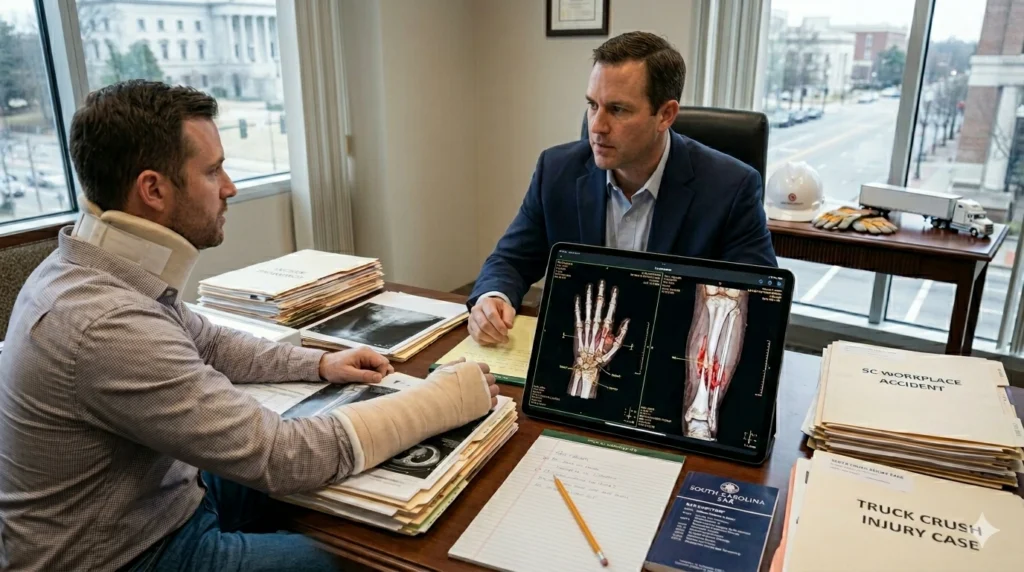
If you suffered a crush injury in a South Carolina truck, workplace, or construction accident, your case may involve serious complications that develop over time and are often undervalued at the start. A crush injury lawyer in South Carolina helps you understand the medical risks like compartment syndrome, nerve damage, and possible amputation, and how they affect your claim value. You’ll learn who may be liable, what compensation is available, and how these complex injuries are properly proven under SC law.
What Makes a Crush Injury Lawyer South Carolina Case Different From a Fracture
If you’re working with a crush injury lawyer in South Carolina, it’s important to understand that a crush injury is far more complex than a standard fracture and is often misjudged in early medical and insurance evaluations. A crush injury occurs when a body part is compressed between two forces for an extended period, damaging not only bone but also muscles, nerves, and blood vessels. This internal damage can continue to worsen even after the external pressure is removed.
Legally, this distinction is critical. Insurance adjusters often rely on initial X-rays and visible fractures to assess value, but those images do not capture tissue death, nerve impairment, or vascular damage. These hidden injuries are frequently the most serious and costly parts of the claim.
The Medical Complications That Drive Crush Injury Claim Value
Crush injury cases are often high-value in South Carolina because the damage extends far beyond broken bones and can escalate quickly into life-altering conditions.
Compartment Syndrome
This is a time-critical condition where pressure builds inside muscle compartments, cutting off blood flow. Without emergency surgery (fasciotomy), tissue can die within hours, leading to permanent loss of function, scarring, and long recovery with multiple follow-up procedures. Delayed treatment can also raise potential medical malpractice issues alongside the injury claim.
Nerve Damage
Crush trauma can severely damage peripheral nerves, causing long-term weakness, numbness, or loss of motor control. Depending on severity, recovery may be partial, limited, or impossible, affecting both daily function and future earning capacity.
Amputation Risk
In severe cases, loss of blood flow, infection, or tissue death may require amputation. This introduces additional lifelong costs such as prosthetics, rehabilitation, and chronic pain management, all of which increase claim value significantly.
Crush Syndrome (Systemic Complications)
Severe muscle breakdown can release toxins into the bloodstream, potentially leading to kidney failure (rhabdomyolysis). In severe cases, this may form a crush syndrome kidney failure claim, requiring emergency dialysis and potentially resulting in long-term kidney disease, which adds ongoing medical costs to the claim.
Common Causes of Crush Injuries in South Carolina
The cause of a crush injury determines who is responsible and what legal claims may apply.
Truck and 18-Wheeler Accidents
Crush injuries often occur when a passenger vehicle is pinned or compressed in a collision with a commercial truck. Because of the extreme weight difference, even lower-speed impacts can trap occupants and cause severe limb and body compression.
Construction and Workplace Accidents
Job sites are a leading source of crush injuries in South Carolina. Common causes include heavy equipment rollovers, machinery entrapment, structural collapses, and trench cave-ins. These incidents often form the basis of a construction crush injury claim SC, and they may involve both workers’ compensation and third-party liability claims.
Pedestrian and Bicycle Accidents
When a pedestrian or cyclist is struck and pinned against a vehicle or fixed object, the resulting force can cause serious crush injuries to the legs, pelvis, or torso, often combined with fractures and deep tissue damage.
What Your SC Crush Injury Claim Can Recover
South Carolina law allows crush injury victims to recover both financial losses and non-financial harm.
Economic Damages
- Emergency surgery, including fasciotomy and vascular repair
- Hospital and ICU care
- Follow-up and reconstructive surgeries
- Physical and occupational therapy
- Nerve damage treatment and pain management
- Future medical care through life care planning
- Lost wages and reduced earning capacity
- Amputation-related costs, including prosthetics and replacements
Non-Economic Damages
- Pain and suffering, including chronic nerve pain
- Permanent disability or loss of function
- Disfigurement from scarring or amputation
- Emotional distress from traumatic injury events
If your crush injury is part of a broader multi-injury accident, damages may be combined and evaluated together in a single claim.
Final Takeaway on Crush injury lawyer South Carolina
Crush injuries are rarely straightforward, and the most serious consequences often develop after the initial emergency treatment. In an industrial accident crush injury SC, what may look like a manageable fracture on day one can quickly evolve into compartment syndrome, nerve damage, crush syndrome, or even amputation, each significantly increasing the value and complexity of a claim.
Because insurers tend to evaluate these cases early and rely on incomplete medical information, initial settlement offers often fail to reflect the true long-term impact. A properly documented claim must account for evolving complications, future medical needs, and the full extent of functional loss before any resolution is considered.
For injured victims in South Carolina, the key issue is timing and completeness: once a claim is settled, additional medical complications cannot be added later.
Don’t Settle Before the Full Injury Is Known
Crush injuries can worsen over time, with complications like compartment syndrome, nerve damage, or amputation risk appearing after the initial accident, and early offers often miss these costs.
Spartan Law offers free consultations for crush injury victims across South Carolina. Thomas Conits handles every case personally, with no fee unless compensation is recovered. Call 864-777-1000 anytime or schedule online.
Frequently Asked Questions
1. What is compartment syndrome and how does it affect my crush injury claim in SC?
It’s a surgical emergency where pressure cuts off blood flow after a crush injury. If not treated quickly, it can cause permanent tissue damage, increasing medical costs and potential claim value.
2. Can I recover damages for nerve damage caused by a crush injury in South Carolina?
Yes. You can claim medical treatment costs, chronic pain, and long-term functional limits that affect work and daily life.
3. What if my crush injury required amputation? Does that change the claim?
The claim increases to include prosthetics, rehabilitation, lifelong care costs, and higher non-economic damages for permanent loss.
4. Who is liable for a crush injury at a South Carolina construction site?
Multiple parties may be liable, including contractors, subcontractors, property owners, or equipment manufacturers, depending on fault.
5. How long do I have to file a crush injury claim in South Carolina?
Generally three years from the injury date, but shorter deadlines may apply in cases involving government property or agencies.
Key Takeaways
- Crush injuries often involve hidden damage like muscle death, nerve injury, and vascular disruption that may not appear on early scans, making early settlements undervalued.
- Compartment syndrome requires urgent surgery; delays can cause permanent damage and may lead to additional malpractice claims.
- Severe cases may trigger crush syndrome, where muscle breakdown can cause kidney failure and long-term medical costs.
- Workplace crush injuries in SC may support both workers’ compensation and third-party injury claims against other responsible parties.
- Amputation cases include lifelong prosthetic and rehabilitation costs, requiring a full life care plan before settlement.