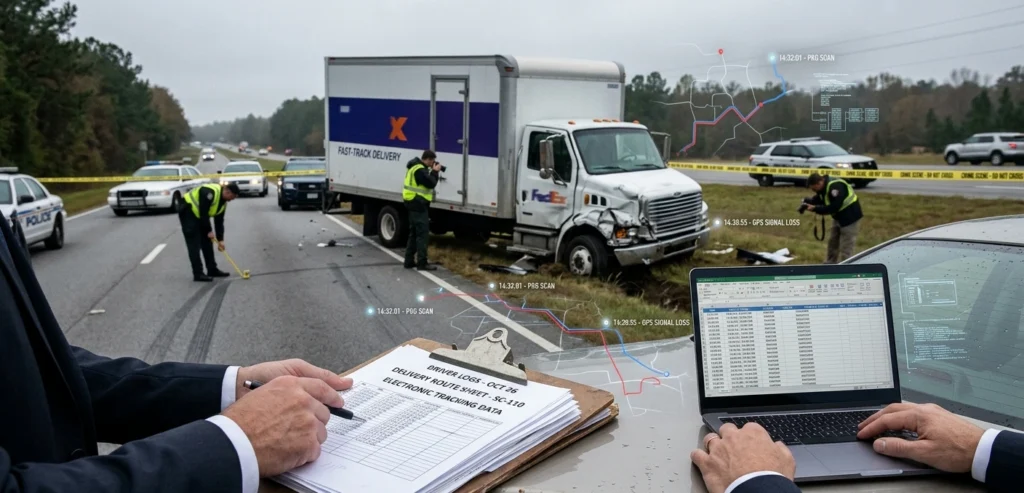
FedEx truck accident liability in South Carolina depends on whether the crash involves FedEx Express employees or FedEx Ground’s contractor model, but the “right to control” test and federal safety rules can still establish FedEx liability despite ISP defenses. These cases require fast action to preserve evidence, identify all liable parties, and pursue full compensation before critical data is lost or insurers control the claim.
How a FedEx Truck Accident Attorney South Carolina Proves Liability
FedEx truck accident liability in South Carolina depends on understanding how FedEx Express and FedEx Ground operate. FedEx Express uses direct employees, creating a clear employer liability structure, while FedEx Ground relies on independent service providers (ISPs) who own trucks and hire drivers under contract. This division is central in FedEx truck accident attorney South Carolina cases because it determines who can be held responsible after a crash.
That ISP structure is FedEx’s primary liability defense. When a FedEx Ground truck causes a crash, FedEx’s first position is that the driver works for an ISP, not FedEx, and FedEx bears no responsibility for the driver’s negligence. South Carolina courts examine the actual working relationship rather than the contract label, and FedEx’s operational control over ISP drivers is extensive enough to challenge that defense in most cases.
The Legal Difference Between FedEx Express and FedEx Ground Crashes
If a FedEx Express truck caused your crash, liability is more straightforward because drivers are direct FedEx employees, so vicarious liability applies and FedEx’s insurance is typically available without dispute.
FedEx Ground cases are more complex due to the ISP contractor model, but in FedEx truck accident attorney South Carolina claims, FedEx can still be held liable when its control over drivers through routes, scanning systems, uniforms, and delivery schedules satisfies the “right to control” test and overcomes the contractor defense.
What FedEx Controls in Day-to-Day ISP Operations
FedEx Ground’s defense relies on the claim that ISPs operate independently. The reality is that FedEx controls the key elements of every delivery ISP drivers make. Documenting that control is what establishes liability at the FedEx level rather than limiting the claim to the ISP alone.
Here is what FedEx Ground controls directly over ISP drivers:
- Package scanning and tracking: Every package must be scanned at specific points in the delivery sequence using FedEx systems. This creates a digital record of every stop and the driver’s compliance with FedEx procedures.
- Delivery windows and route assignments: FedEx assigns the route and the delivery windows ISP drivers must meet. Those windows directly determine the pace at which drivers must operate.
- Vehicle branding and appearance standards: ISP trucks must carry FedEx branding, and drivers must wear FedEx uniforms. The public sees a FedEx truck operated by a FedEx driver.
- Performance metrics and termination authority: FedEx monitors ISP performance and can terminate the ISP contract if performance standards are not met, effectively ending the driver’s livelihood. That level of control goes well beyond a standard contractor relationship.
- Training standards: FedEx requires ISPs to use FedEx-approved training programs for their drivers.
When a company controls the route, the schedule, the appearance, the training standards, and the performance metrics of another company’s workforce, South Carolina courts have strong grounds to hold that controlling company liable.
Who Can Be Held Liable After a FedEx Truck Crash in SC
FedEx truck accident cases in South Carolina can produce multiple liable defendants depending on the division involved, the ownership of the vehicle, and the specific circumstances of the crash. Identifying every liable party from the start is how full recovery is built.
The defendants that typically apply in FedEx crash cases include:
- The ISP company (FedEx Ground cases): The driver’s direct employer faces vicarious liability for the driver’s negligence while on duty. ISPs are required to carry commercial auto insurance as a condition of the FedEx Ground contract.
- FedEx Ground Package System, Inc.: Faces liability through the right to control test when its operational control over the ISP driver’s work is established. Also faces direct negligence claims when its delivery window requirements or training failures contributed to the crash.
- FedEx Corporation: The parent company can be implicated in cases involving gross negligence, systemic safety failures, or where the specific conduct involved goes beyond the ISP relationship to corporate policy decisions.
- FedEx Express (direct employee cases): As the direct employer of Express drivers, FedEx is straightforwardly liable for its employees’ negligence while on duty.
- Vehicle manufacturers or maintenance contractors: Where a mechanical defect or improper maintenance contributed to the crash, additional defendants may carry separate liability alongside FedEx.
South Carolina Law and How It Applies to FedEx Accident Claims
South Carolina law gives FedEx crash victims strong legal tools. Employers can be held liable for driver negligence, and the “right to control” test can extend liability to FedEx even under a contractor model. Negligent entrustment also applies if an unsafe driver was allowed on the road.
The state follows modified comparative negligence, meaning you can recover if you are 50 percent or less at fault, though insurers will try to increase your share. While the statute of limitations is generally three years, key evidence can disappear quickly without early legal action.
Federal Regulations That Apply to FedEx Truck Operations in SC
FedEx trucks operating in interstate commerce are subject to Federal Motor Carrier Safety Administration regulations alongside South Carolina state law. Those regulations govern driver qualification, hours of service, vehicle maintenance, and cargo securement. When FedEx or an ISP violates FMCSA rules and a crash results, that violation establishes negligence per se under South Carolina law, meaning the violation itself is treated as direct evidence of negligence without requiring additional proof.
Key FMCSA regulations that apply to FedEx truck crashes include:
- Hours-of-service rules: Commercial drivers cannot exceed 11 hours of driving after 10 consecutive hours off duty. FedEx’s delivery window pressure can push ISP drivers to violate these limits.
- Driver qualification requirements: ISPs must verify CDL status, conduct drug and alcohol testing, and review accident history before placing drivers on routes. Failures here create direct negligence liability.
- Vehicle maintenance standards: Pre-trip and post-trip inspections are federally required. Maintenance records showing known defects that were not repaired before a crash become powerful evidence.
- Electronic logging device requirements: ELD data captures driving hours, speed, and location. This data must be preserved through a legal hold immediately after any FedEx truck crash.
Understanding how South Carolina law handles big truck accident liability covers the full interaction between FMCSA regulations and SC personal injury law in commercial vehicle cases.
Types of FedEx Trucks Involved in South Carolina Crashes
Not every FedEx vehicle presents the same risk profile or produces the same liability framework. The type of FedEx truck involved in your crash affects which regulations apply, which defendants carry liability, and what evidence your attorney needs to pursue.
The FedEx vehicles most commonly involved in South Carolina crashes include:
- FedEx Ground delivery vans and sprinter vans: The most common FedEx vehicles on residential roads. Operated by ISP drivers under the contractor model. Weight ranges from 8,500 to 15,000 pounds when loaded.
- FedEx Express delivery trucks: Operated by direct FedEx employees. Standard employer vicarious liability applies without the contractor defense.
- FedEx Freight semi-trucks and 18-wheelers: FedEx Freight operates large commercial trucks on South Carolina interstates carrying business-to-business freight. These vehicles are subject to full FMCSA heavy vehicle regulations and carry the same catastrophic injury potential as any commercial tractor-trailer. The tractor-trailer accident attorney page for South Carolina covers the specific liability framework for large commercial truck crashes.
- FedEx Custom Critical vehicles: Specialty vehicles carrying time-sensitive or high-value freight under expedited delivery pressure. Driver fatigue and speeding are common contributing factors in crashes involving these vehicles.
What Injuries FedEx Truck Crashes Cause and What They Cost
FedEx delivery vans and freight trucks range from 8,500-pound vans to 80,000-pound semi-trucks, often causing more severe injuries than standard car crashes. Common injuries include brain trauma, spinal damage, fractures, internal injuries, and chronic soft tissue conditions.
Real case results show recovery depends on documenting full losses, including medical costs, future care, lost income, and long-term impact, not just initial expenses.
Evidence That Makes or Breaks a FedEx Truck Accident Case in SC
FedEx truck accident cases produce a category of evidence that standard car crash cases do not. That evidence belongs to FedEx, the ISP, or both, and none of it is automatically preserved after a crash.
Critical evidence in FedEx truck accident cases includes:
- FedEx package scanning and tracking data: Documents exactly where the driver was, what deliveries were completed, and the timing of each stop in the delivery sequence.
- ISP driver qualification files: Establishes whether the ISP verified CDL status, conducted required drug testing, and reviewed the driver’s accident history before assignment.
- ELD and black box data: Records driving hours, speed, and location in the period leading up to the crash. Can be overwritten within 30 days without a legal hold.
- Vehicle maintenance and inspection records: Shows whether pre-trip inspections identified defects that were not repaired before the crash.
- Dashcam footage from the FedEx vehicle: Many FedEx vehicles carry forward and cabin-facing cameras. Footage typically overwrites within 24 to 72 hours.
- FedEx route assignment and delivery window records: Establishes whether the assigned delivery schedule required unsafe driving speeds to complete on time.
A legal hold letter must be sent to FedEx and the ISP within the first 24 to 48 hours of the crash. Without it, the evidence that establishes liability at the FedEx level disappears before litigation begins.
Why Choosing the Right Attorney Changes the Outcome in FedEx Cases
FedEx’s legal and insurance teams act immediately after a crash, sending adjusters, building defenses, and positioning the ISP contractor argument before most victims speak to an attorney. Fast legal representation is critical to pursue full FedEx liability instead of limiting the claim to the ISP.
Thomas Conits at Spartan Law has represented South Carolina injury victims since 2021 and personally handles every FedEx truck case, providing direct attorney access and statewide representation.
FedEx Truck Accident Attorney South Carolina Guide to Liability: Final Takeaway
FedEx truck accident cases in South Carolina are rarely simple because liability depends on whether the crash involves FedEx Express employees or FedEx Ground’s independent contractor system. While FedEx often tries to avoid responsibility by pointing to its ISP structure, South Carolina law allows victims to pursue FedEx directly when evidence shows operational control, safety failures, or regulatory violations.
Successful claims depend on identifying all liable parties, preserving critical evidence within hours or days, and using legal tools like the right to control test, FMCSA regulations, and comparative negligence rules to build full liability. Because FedEx and its insurers act immediately after a crash, early legal representation is essential to prevent evidence loss and ensure every available source of compensation is pursued.
If a FedEx Truck Hit You in South Carolina, Act Within 48 Hours
Time matters. FedEx crash evidence can disappear within hours, and insurers act immediately to control the narrative. Don’t wait for early action to protect your claim.
Thomas Conits at Spartan Law preserves evidence fast and pursues full compensation from day one. Call 864-777-1000 now for a free consultation. No fee unless we win.
Frequently Asked Questions
1. Can I sue FedEx directly if a FedEx Ground driver hit me in South Carolina?
Yes. Courts use the “right to control” test, allowing claims against FedEx Ground despite the ISP contractor model.
2. What is the difference between a FedEx Ground and FedEx Express claim?
FedEx Express involves direct employee liability. FedEx Ground requires proving FedEx’s control over ISP drivers.
3. What insurance coverage applies to a FedEx truck crash in South Carolina?
Coverage may include ISP insurance, FedEx’s policy, corporate coverage, and your underinsured motorist coverage.
4. How quickly does evidence disappear after a FedEx truck crash?
Dashcam footage may be lost in 24–72 hours, and ELD data within 30 days. A legal hold within 48 hours is critical.
5. What if FedEx’s insurer contacts me before I have an attorney?
Avoid recorded statements. Insurers use them to shift fault and reduce payouts—refer them to your attorney.
6. Does FMCSA regulation apply to FedEx Ground vans in South Carolina?
It depends on weight and interstate use. Larger or interstate vehicles must follow full FMCSA regulations.
Key Takeaways
- FedEx Express uses employees; FedEx Ground uses contractors, creating liability challenges.
- South Carolina’s control test can still hold FedEx liable despite contractor claims.
- Multiple parties may be liable, including ISP, FedEx Ground, and FedEx Corporation.
- FMCSA violations can serve as direct proof of negligence.
- Critical evidence can disappear quickly without a legal hold.
- Legal representation helps pursue full compensation across all coverage layers.