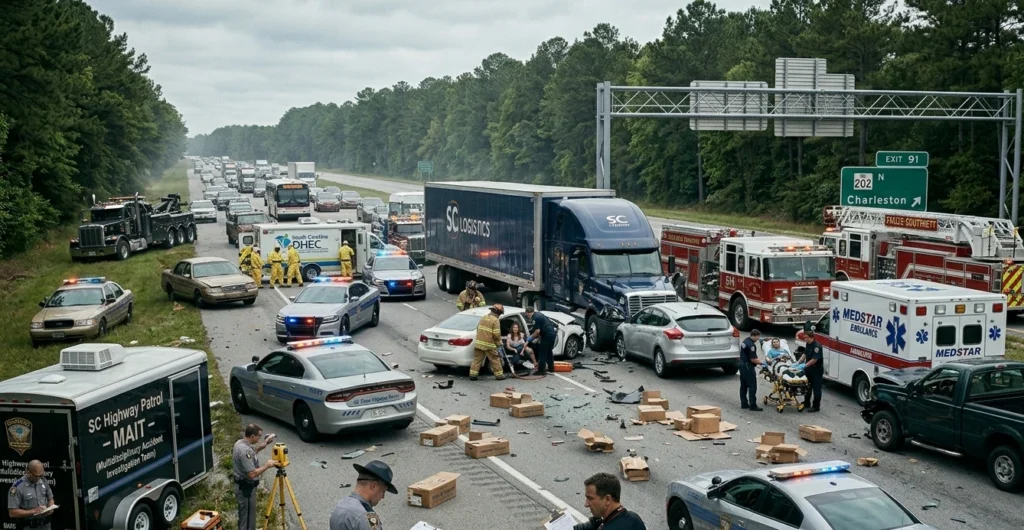
If you’ve been injured in a South Carolina 18-wheeler accident, these cases are more complex than typical crashes due to federal rules, multiple liable parties, and severe injuries. This guide is for victims seeking compensation and clarity on their rights. You’ll learn how Federal Motor Carrier Safety Administration (FMCSA) regulations, liability factors, and state laws affect your claim and how to maximize your settlement.
What Makes 18-Wheeler Accidents Different in South Carolina?
18-wheeler accidents in South Carolina are significantly different from standard car crashes because of the massive size and weight of commercial trucks, as well as the strict federal safety rules that govern the trucking industry. These factors often make the investigation and legal process more complex and require a deeper analysis of how the accident occurred and who may be responsible.
Key Factors:
- Federal Regulations: The Federal Motor Carrier Safety Administration (FMCSA) establishes strict rules on driver working hours, vehicle maintenance standards, and driver qualifications to promote road safety and reduce fatigue-related crashes.
- Liability: Responsibility may extend beyond just the truck driver and can include multiple parties such as the trucking company, maintenance providers, vehicle owners, and cargo loading teams.
- Severity: Injuries are often far more severe than in typical accidents due to the extreme force generated by 18-wheelers, frequently resulting in long-term medical complications and significant financial impact.
Federal Motor Carrier Safety Administration (FMCSA) Regulations
The Federal Motor Carrier Safety Administration (FMCSA) is responsible for enforcing strict safety standards in the trucking industry to reduce accidents and protect road users. When these regulations are violated, they often play a critical role in proving fault and establishing liability in 18-wheeler accident cases.
Key Rules
- Hours-of-Service (HOS): Limits how long drivers can operate without rest, helping prevent fatigue-related crashes. Violations may indicate driver negligence and unsafe practices.
- Electronic Logging Devices (ELDs): These systems automatically record driving hours and provide important digital evidence in cases involving fatigue or rule violations.
- Vehicle Maintenance: Trucking companies must regularly inspect and maintain their vehicles, including brakes, tires, and engine systems. Poor maintenance can directly lead to serious accidents.
- Driver Qualifications: Drivers must meet strict requirements, including proper commercial licensing, medical evaluations, and ongoing training to ensure they are fit to operate large commercial vehicles safely.
Impact on Liability
When FMCSA regulations are violated, it often signals negligence. These violations can significantly strengthen injury claims against truck drivers, trucking companies, and other responsible parties.
Multi-Party Liability in 18-Wheeler Accidents
18-wheeler accident cases are often complex because responsibility is not limited to a single driver. Instead, multiple individuals or companies may share legal responsibility depending on how the crash occurred, making investigation and evidence gathering especially important.
Potentially Liable Parties
- Truck Driver: May be liable for negligent actions such as speeding, distracted driving, DUI, or violations of Hours-of-Service rules.
- Trucking Company: Can be responsible for inadequate training, unsafe hiring practices, or failing to properly maintain fleet vehicles.
- Vehicle Owner: May share liability if the truck is leased and mechanical or maintenance issues contributed to the accident.
- Cargo Loaders: Can be held responsible if improper loading, such as unbalanced or unsecured cargo, caused the truck to tip or crash.
- Maintenance Providers: May be liable if improper repairs or failure to maintain critical systems like brakes or tires led to mechanical failure.
Identifying the role of each party is essential to building a strong claim and securing full compensation.
Severe Injuries from 18-Wheeler Accidents
Injuries resulting from 18-wheeler accidents are often extremely severe due to the massive size, heavy weight, and high impact force of commercial trucks. These collisions frequently lead to life-changing physical harm that requires long-term medical treatment, rehabilitation, and ongoing care.
Common Injuries
- Traumatic Brain Injury (TBI): Can lead to long-term cognitive impairment, memory loss, and difficulty with motor functions.
- Spinal Cord Injuries: May result in partial or complete paralysis and permanent disability affecting mobility and independence.
- Broken Bones and Fractures: Often require surgeries, physical therapy, and extended recovery periods.
- Internal Injuries: Damage to organs such as the liver, lungs, or spleen may require emergency surgery and intensive care.
- Amputations: In severe crashes, victims may suffer the loss of limbs, significantly impacting quality of life.
Compensation
Victims may be entitled to recover compensation for medical expenses, lost wages, rehabilitation costs, and pain and suffering. Because of the seriousness of these injuries, compensation amounts are often significantly higher than in standard motor vehicle accident cases.
South Carolina’s Legal Framework for 18-Wheeler Accidents
South Carolina law plays a critical role in determining how 18-wheeler and tractor-trailer accident claims are handled. These rules affect who can recover compensation, how fault is assigned, and the strict deadlines that must be followed to pursue a claim after a serious crash involving a commercial truck.
Comparative Negligence in South Carolina
South Carolina follows a modified comparative negligence rule. This means an injured person can still recover compensation even if they were partially responsible for the accident, as long as their share of fault does not exceed 50%. If you are found partially at fault, your total compensation will be reduced in proportion to your percentage of responsibility. For example, if you are 20% at fault, your recovery would be reduced by 20%. This rule is especially important in 18-wheeler cases, where liability is often shared among multiple parties.
Statute of Limitations
In South Carolina, you generally have three years from the date of the accident to file a personal injury claim. This deadline is strictly enforced, and failing to file within this time frame can permanently prevent you from recovering damages. Because evidence in truck accident cases can fade quickly, it is important to begin the legal process as soon as possible to protect your rights and strengthen your claim.
What Damages Can You Recover After an 18-Wheeler Accident?
Victims of 18-wheeler accidents in South Carolina may be entitled to recover a wide range of damages depending on the severity of the crash, the extent of injuries, and the financial and emotional impact on their lives. Because these accidents often involve serious injuries and multiple liable parties, the total compensation available is typically higher than in standard vehicle accidents.
1. Economic Damages
Economic damages cover the direct financial losses caused by the accident and are usually supported by bills, receipts, and employment records.
- Medical Expenses: Includes emergency treatment, ambulance services, hospital stays, surgeries, follow-up care, physical therapy, rehabilitation programs, prescription medications, and future medical treatment needs.
- Lost Wages: Compensation for income lost while recovering, as well as reduced earning capacity if injuries prevent you from returning to your previous job or working full time in the future.
- Property Damage: Covers the cost to repair or replace your vehicle and any personal property damaged in the crash, such as electronics or other belongings.
2. Non-Economic Damages
Non-economic damages compensate for the personal, physical, and emotional impact of the accident, which do not have a fixed monetary value.
- Pain and Suffering: Compensation for physical pain, emotional distress, anxiety, trauma, and the overall impact the injuries have on your daily life and independence.
- Loss of Consortium: In cases involving long-term disability or wrongful death, family members may recover damages for the loss of companionship, affection, guidance, and support.
3. Punitive Damages
Punitive damages may be awarded in cases where the at-fault party acted with gross negligence, recklessness, or intentional misconduct, such as severe safety violations or extreme disregard for others’ safety. These damages are designed to punish the wrongdoer and discourage similar dangerous behavior in the future, rather than to compensate the victim directly.
How to Maximize Your 18-Wheeler Accident Settlement
Maximizing your 18-wheeler accident settlement in South Carolina requires a strategic approach, strong supporting evidence, and a clear understanding of the full extent of your damages. Because these cases often involve multiple liable parties and large insurance policies, careful preparation can significantly impact the outcome of your claim and the compensation you receive.
1. Preserve Evidence
Strong evidence is one of the most important factors in building a successful claim. The more documentation you can secure early, the stronger your case will be.
- Truck Driver Logs: Obtain the driver’s Hours-of-Service (HOS) logs to determine whether fatigue or federal regulation violations contributed to the crash.
- Black Box Data: Many commercial trucks are equipped with electronic logging or event data recorders that capture speed, braking patterns, and driving behavior before the accident.
- Maintenance Records: Reviewing maintenance and inspection records can reveal whether mechanical failures, poor repairs, or missed inspections played a role in the accident.
2. Consult With an Attorney
Working with an experienced 18-wheeler accident attorney South Carolina is critical to maximizing your settlement. An attorney can help identify all responsible parties, gather and preserve key evidence, calculate the full value of your damages, and negotiate with insurance companies that often try to minimize payouts. Legal representation also ensures your rights are protected throughout the process.
3. Don’t Accept Early Offers
Insurance companies frequently present early settlement offers that are lower than what your claim may actually be worth. These offers are often made before the full extent of injuries, future medical needs, and long-term financial losses are known. It is important to fully evaluate your case and understand its long-term value before agreeing to any settlement.
Why You Need an 18 Wheeler Accident Attorney South Carolina
18-wheeler accident claims in South Carolina are complex, involving strict regulations, multiple liable parties, and severe injuries. Working with an experienced attorney helps you navigate Federal Motor Carrier Safety Administration rules, preserve critical evidence, and maximize your compensation. Taking prompt legal action can make a significant difference in securing the financial recovery you deserve.
Speak With a South Carolina Truck Accident Attorney Today
If you’ve been involved in an 18-wheeler accident, it’s crucial to consult with a skilled 18-wheeler accident attorney South Carolina as soon as possible. An attorney can guide you through the process, preserve important evidence, and ensure that your rights are protected.
Frequently Asked Questions
1. How much is a typical 18-wheeler accident settlement worth in South Carolina?
Settlement amounts vary widely depending on the facts of each case. In South Carolina, compensation can range from around $25,000 to as high as $5 million. Factors that influence the value include the severity of injuries, long-term medical needs, lost income, property damage, the degree of negligence involved, and how many parties share liability.
2. Who can be held liable in an 18-wheeler accident?
Liability in an 18-wheeler accident is often shared among multiple parties rather than just one driver. This may include the truck driver, trucking company, cargo loading teams, vehicle owners, and maintenance providers. Each party may be responsible depending on how their actions or negligence contributed to the crash.
3. What is the FMCSA, and how does it impact my case?
The Federal Motor Carrier Safety Administration (FMCSA) is the federal agency that regulates the trucking industry. It sets strict safety rules for drivers and trucking companies, including limits on driving hours, maintenance requirements, and driver qualifications. Violations of these rules can serve as strong evidence of negligence and may significantly strengthen your injury claim.
4. How long do I have to file an 18-wheeler accident lawsuit in South Carolina?
In most cases, you have three years from the date of the accident to file a personal injury lawsuit in South Carolina. If you fail to file within this time period, you may lose your legal right to pursue compensation, regardless of the strength of your case.
5. Can I still recover compensation if I was partially at fault for the accident?
Yes. South Carolina follows a modified comparative negligence rule, which means you can still recover damages as long as you are less than 51% at fault. However, your total compensation will be reduced based on your percentage of responsibility for the accident.
Key Takeaways
- 18-wheeler accident claims often involve multiple parties and are governed by strict FMCSA regulations
- Evidence like driver logs, black box data, and maintenance records is crucial for proving liability
- Compensation can include medical expenses, lost wages, pain and suffering, and punitive damages
- Hiring an experienced attorney early improves your chances of receiving fair compensation