Most common
Car Accidents
Highway-speed traffic on US-76/178 meeting local turns at the square, and two-lane wrecks on SC-20. Tom takes on the insurance company; you take on getting better.
Learn more →
Hurt on US-76, on SC-20, or anywhere in the town under the Standpipe? Tom Conits drives to Belton — you don't drive to Greenville. Free consultation, no fee unless we win.
Belton is a junction town — it always has been. It was incorporated in 1855 where the Blue Ridge Railroad's branch to Anderson met the Greenville and Columbia line, took its name from Judge John Belton O'Neall, the G&C's president, and laid out its public square around the first depot. Rail junctions grow into road junctions: today US-76 and US-178 run through town together and meet SC-20 and SC-247 at the edge of the business district, so a healthy share of Anderson County's traffic still funnels past Belton's square every day.
Over it all stands the Standpipe — the 155-foot concrete water tower finished in 1909, the tallest of the three standpipe towers left in South Carolina, on the National Register of Historic Places since 1987 and built to hold 165,000 gallons over downtown. The town throws it a festival: the Standpipe Heritage and Arts Festival takes over the square on the first Saturday of every October. And every June since 1957, the Palmetto Championships — the state's biggest junior tennis tournament — bring 450 to 480 young players and their families to the town that keeps the South Carolina Tennis Hall of Fame in its historic depot. The 2020 census counted 4,335 residents. On the right weekend, the roads carry a lot more people than that.
Tom Conits understands towns like Belton because he grew up in the working Upstate — in his family's Greek restaurant, where he's held a job since he was fifteen and still takes shifts. Charleston School of Law and years at several of South Carolina's top personal injury firms taught him how big firms run cases; his own practice is deliberately the opposite. One lawyer, reachable directly, who shows up at your door. When a Belton client calls (864) 777-1000, Tom answers — and every consultation is free, with no fee unless we win.
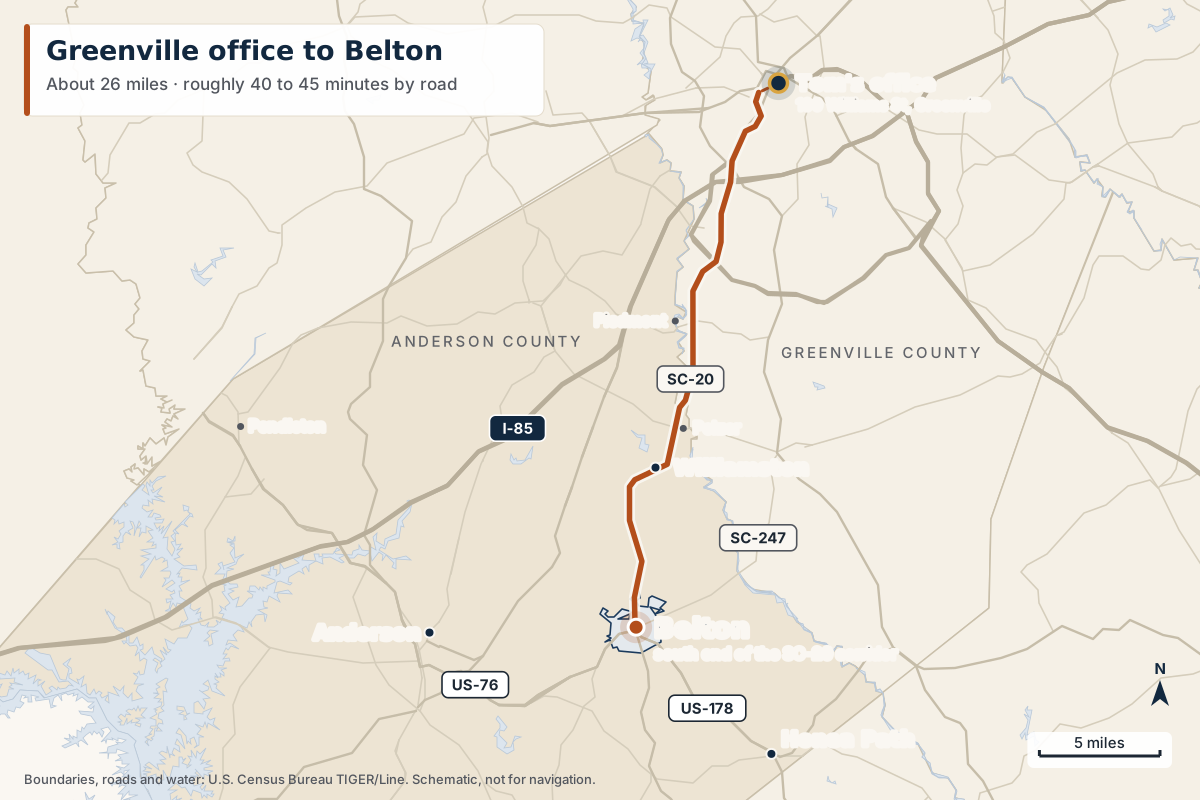
Belton sits about 26 miles from our office at 100 Williams St in downtown Greenville — roughly 40 to 45 minutes by road. That drive is Tom's problem, not yours. After a serious injury you may be off work, out of a car, or recovering from surgery; the last errand you need is a trip to a law office in another county.
So the office comes to you. Tom sits down wherever suits you — the kitchen table, the porch, a hospital room in Anderson or Greenville — listens to the whole story, and then talks through the practical picture: your medical bills and who ends up paying them, what the insurance adjuster will do next and why the recorded statement can wait, what deadlines are running, and what he honestly thinks your claim is worth investigating. Plain English or Greek, whichever your family prefers. If you hire him, the paperwork is signed on the spot and the file opens that day.
"Every client gets my personal cell number. Call or text me directly — you'll never chase a case manager."
Clients hear back from me the same day — and for emergencies, anytime.
— Thomas Spiro Conits
Belton sits squarely in Anderson County, so a lawsuit over a Belton wreck is generally filed in the Anderson County Court of Common Pleas — the civil court for disputes over $7,500 — at the courthouse at 100 South Main Street in downtown Anderson, a straight run up US-76/178 from Belton's square.
Venue still has to be proven, not assumed. Under S.C. Code § 15-7-30, a suit against a South Carolina resident generally belongs in the county where the defendant lived when the claim arose or where the most substantial part of the events occurred. The traffic through Belton's junction comes from every direction — Anderson one way, Honea Path the other, the SC-20 towns to the north — and the defendant who hit you may live in none of them. Tom answers the venue question with evidence before he files, because a suit filed in the wrong county is a delay the insurance company didn't have to earn.
Your part in the court process is small by design: Tom makes the filings and the appearances, keeps you posted directly, and — since most injury claims settle before trial — there's a good chance you'll never stand in a courtroom at all.
The combined US-76 and US-178 carry through-traffic along Anderson Street and Brown Avenue, straight past the business district — toward Anderson to the northwest and Honea Path to the southeast. When a federal highway doubles as a downtown street, through-drivers moving at highway speed meet local drivers turning across them, and the crashes that result are rarely gentle.
SC-20 leaves Belton for Williamston, Pelzer, and Piedmont — a two-lane commuter run that ties four towns to each other and to Greenville beyond. Two-lane roads punish small mistakes: a moment's distraction becomes a head-on or a run-off-road wreck, the kinds of collisions that fill trauma bays.
SC-247 splits off North Main Street to the northeast — a few hundred feet from the US-76/178 junction — and crosses the railroad tracks before it leaves town. Belton's street grid was drawn around rail lines, and crossings and skewed intersections are part of daily driving here — geometry that demands more attention than out-of-town drivers always give it.
The first Saturday of October puts the Standpipe Heritage and Arts Festival — and its crowds — on the square. June brings the Palmetto Championships and hundreds of visiting tennis families who don't know the roads. More pedestrians, more parking maneuvers, more unfamiliar drivers: the town's best weekends are also its most dangerous ones to walk through a parking lot.
For serious Belton wrecks, EMS often runs up US-76/178 to AnMed Medical Center at 800 N. Fant Street in Anderson, whose emergency department is a Level III trauma center. The worst cases are frequently flown or driven to Greenville Memorial, the Upstate's Level I trauma center. Whichever ER treated you, those records become the spine of your claim — and Tom collects every page, from triage notes to the last physical-therapy bill. That ride to Anderson or Greenville is part of what makes a rural wreck different; Tom's article on rural road accidents in the Upstate explains why the miles matter — to your recovery and to your claim.
Photo slot: belton-standpipe
After a wreck in a town like Belton, the other driver's insurance company often moves fast — a friendly call, a request for a recorded statement, sometimes a settlement check while you're still in a brace. Speed is not generosity. An early offer is priced before anyone knows what your treatment will ultimately cost, and once you sign the release, the claim is closed forever — the surgery you need next spring is your problem, not theirs.
The recorded statement works the same way. You're not required to give one to the other driver's insurer, and adjusters are trained to ask questions whose answers shrink claims. The safe sequence is simple: get treated, keep every record, and let a lawyer do the talking. Tom deals with adjusters every working day; it costs you nothing to put him between you and them.
If you already have an offer in hand, don't guess at whether it's fair. Tom will read it for free and tell you straight — (864) 777-1000. And if you want to see what injury claims have actually resolved for, the results page shows recent recoveries net to the client, with the context that makes the numbers mean something.
Most common
Highway-speed traffic on US-76/178 meeting local turns at the square, and two-lane wrecks on SC-20. Tom takes on the insurance company; you take on getting better.
Learn more →
Two-lane country
Riders know the roads around Belton; the danger is the driver who "never saw the bike." Motorcycle cases carry a bias problem, and Tom builds them to beat it.
Learn more →
Stores, squares, events
Businesses and event grounds owe their visitors reasonably safe premises. When a hazard nobody fixed puts you on the ground, that's a premises case — and it deserves a serious lawyer.
Learn more →
The hardest cases
When a family loses someone to a preventable wreck, the claim belongs to the people left behind. Tom handles these cases with the gravity they demand — personally, start to finish.
Learn more →
If your situation doesn't fit a category above, call anyway: (864) 777-1000. If Tom isn't the right lawyer for it, he'll say so — and point you toward someone who is.
I personally drive to clients' homes across Greenville and the surrounding counties — hospital rooms and kitchen tables included. You were just hurt; the last thing you need is a trip to a law office.
— Thomas Spiro Conits
Belton anchors the southern end of the SC-20 corridor, and Tom serves every town along it the same way — he drives to you.
7 miles up SC-20
The mineral-spring town just up Highway 20 — about 13 minutes north of the square.
Learn more →
Farther up the corridor
Past Pelzer at the top of the SC-20 run, where the corridor crosses into Greenville County.
Learn more →
The county's west side
The historic Village Green town near Clemson — same county, same courthouse, same promise.
Learn more →
The full list keeps growing — see the Areas We Serve page, and read how house calls work on I Come To You.
Yes. Belton is about 26 miles from Tom's office at 100 Williams St in downtown Greenville — call it 40 to 45 minutes — and Tom makes that drive for clients regularly. Kitchen table, front porch, hospital room: you pick the spot, and he brings the paperwork. You never have to come to Greenville, though you are always welcome.
Belton is in Anderson County, so a lawsuit is generally filed in the Anderson County Court of Common Pleas at the courthouse at 100 South Main Street in downtown Anderson — a straight run up US-76/178 from Belton's square. Venue depends on details like where the defendant lives and where the wreck happened, under S.C. Code § 15-7-30, and Tom resolves that before filing. Either way, the courthouse trips are his, not yours — and most claims settle without a courtroom.
In most South Carolina personal injury cases, three years from the date of injury under S.C. Code § 15-3-530 — and in a wrongful death case, three years from the date of death. Claims against government entities run on different and shorter timelines. Three years sounds like plenty; evidence does not wait that long, so call early.
Maybe — it depends on who controlled the property or the event and whether negligence caused your injury. Property owners and event operators owe visitors reasonably safe conditions, but claims involving government entities follow special rules and shorter deadlines. This is exactly the kind of question a free consultation answers: tell Tom what happened, and he will tell you honestly whether there is a case worth pursuing.
Not before a lawyer reads it. Early offers tend to arrive before anyone knows what your medical care will ultimately cost, and once you sign a release, the claim is over — no matter what bills come later. Tom reviews offers for free. If it is genuinely fair, he will say so. If it is not, you will know exactly what was missing.
Free consultation. No fee unless we win. If getting to an office is hard right now, Tom will come to you.
Office: 100 Williams St, Greenville, SC 29601 · (864) 777-1000