Most common
Car Accidents
Left-turn and crossroads wrecks where 86 meets 20, rear-ends in commuter traffic, distracted drivers on two-lane roads. Tom deals with the insurance company so you can deal with getting well.
Learn more →
Hurt in a wreck on Highway 86, Highway 20, or anywhere around Piedmont? Tom Conits drives to you — whichever side of the river you live on. Free consultation, no fee unless we win.
Piedmont exists because of the Saluda River. Henry Pinckney Hammett organized the Piedmont Manufacturing Company here in 1873, and by 1876 Mill No. 1 was running on the river's water power. Mill No. 2 followed in 1888 — on the other bank — and by 1892 the mills across the river from each other ran some 47,000 spindles and 1,300 looms, one of the largest textile operations in the world at the time. The mill village that grew up around them became the town.
The mills are gone — J.P. Stevens ran them after 1946, production stopped in the 1970s, and fire destroyed the vacant landmark mill in 1983 — but the geography they created still runs the town. The Saluda still pours over the dam in the middle of Piedmont, and that river is not just scenery: it is the county line. The east side of Piedmont is Greenville County; the west side is Anderson County. One community, two counties — a detail that decides real things, from which school district your kids attend (Greenville County Schools feed Woodmont High on one side, Anderson District One feeds Wren High on the other) to which county's courthouse hears your injury case. More on that below, because almost nobody in a wreck knows it until it matters.
Tom Conits represents injured people on both sides of the river, and he does it in person. Tom has worked in his family's Greek restaurant since he was fifteen — he still works shifts there — and after Charleston School of Law and years with several of South Carolina's top personal injury firms, he built his own practice around a simple rule: the client never chases the lawyer. He answers his own phone, he gives every client his cell, and he drives to Piedmont.
Every case is on contingency — no fee unless we win — and every consultation is free. Call or text (864) 777-1000 and you'll talk to Tom, not a screener.
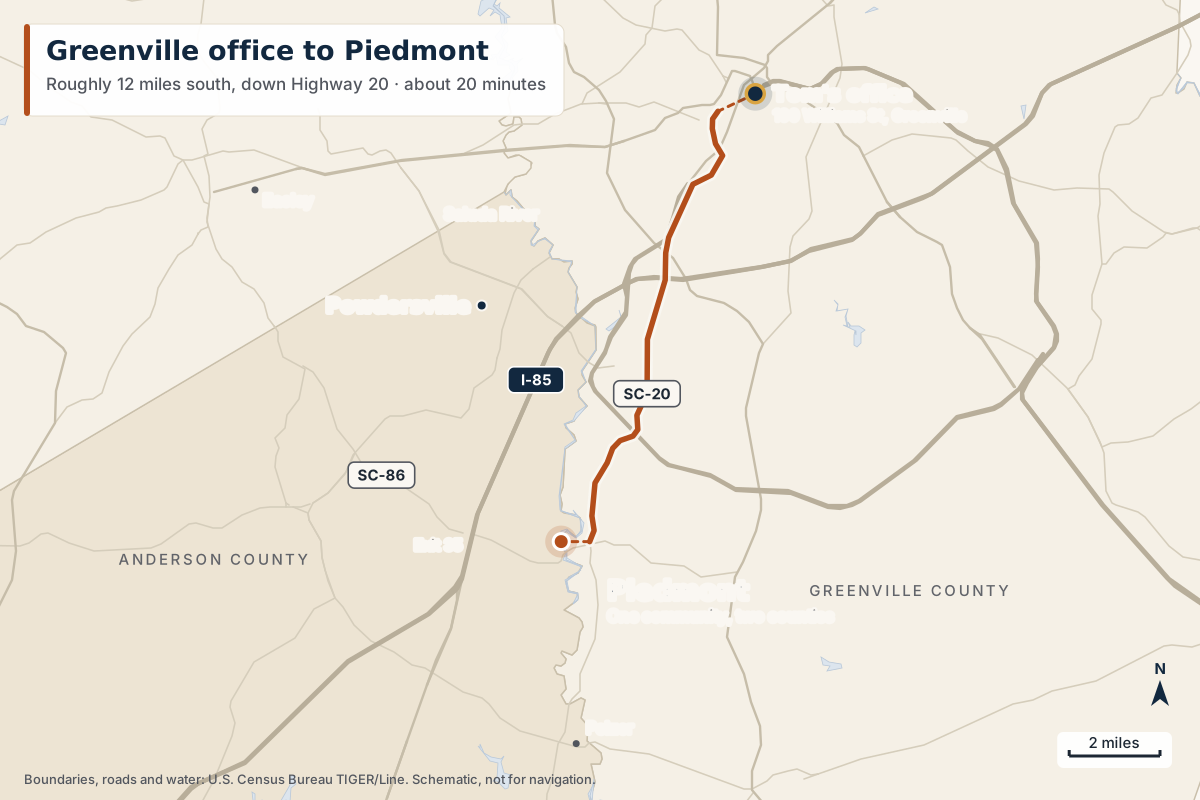
Piedmont sits roughly 12 miles south of downtown Greenville, where Tom's office is — an easy drive down Highway 20, about 20 minutes door to door depending on traffic. Tom makes that drive for clients all the time, because after a serious injury the last thing you need is to arrange a ride into the city to sit in a law office.
Instead, you call, and Tom comes to you: your kitchen table, your porch, your hospital room. He brings the paperwork, explains the whole process in plain English — or in Greek, if that's your family's first language — and leaves you with a plan instead of a stack of forms. Laid up after surgery? Car totaled and no rental yet? None of it slows your case down, because the lawyer travels, not the client.
"Every client gets my personal cell number. Call or text me directly — you'll never chase a case manager."
Clients hear back from me the same day — and for emergencies, anytime.
— Thomas Spiro Conits
Here is the honest answer, which is more useful than a simple one: a Piedmont case can be filed in either Greenville County or Anderson County, and which one is correct depends on the facts of your case — not on your mailing address. The Saluda River through the middle of town is the county line. Cross the bridge and you have changed counties, changed court systems, and changed jury pools. It has been that way since the mill company built No. 1 on one bank and No. 2 on the other.
Which is right for yours? Under South Carolina's venue statute, S.C. Code § 15-7-30, a suit against a South Carolina resident generally belongs in the county where that defendant lived when the claim arose; against an out-of-state defendant, it's generally the county where the most substantial part of the events happened, or where you live. So a wreck on the Greenville side caused by a driver who lives on the Anderson side can raise a genuine venue question — and the answer shapes the case, because Greenville and Anderson juries are different audiences. Tom works that out on day one. Filing in the wrong county hands the insurance company a delay it did not earn.
Either way, the courthouse is Tom's job, not yours. Most injury claims settle before a courtroom ever enters the picture, and clients rarely need to set foot in either building.
Photo slot: piedmont-saluda-dam
Piedmont's roads carry a lot more than mill-village traffic these days. These are the corridors where Tom sees people get hurt.
SC-86 runs about twelve miles between Easley and Piedmont, crosses I-85 at Exit 35 west of town, then crosses the Saluda into Greenville County and meets Highway 20 in Piedmont. It is the road everyone uses to reach the interstate, and it behaves like it: commuters running late for I-85, gravel and delivery trucks, and two-lane stretches where one bad pass or one phone glance becomes a head-on. Crashes at highway speed on a two-lane road are among the worst Tom handles.
SC-20 is the old spine of the west side of the county — it runs from Greenville down through Piedmont and on through Pelzer, Williamston, and Belton, all the way to Abbeville's town square. Through Piedmont it collects everything: commuters to Greenville, school traffic, and local turns across oncoming lanes. Rear-ends and left-turn crashes at the crossroads with 86 and at driveways along the corridor are the everyday wrecks here — and "everyday" doesn't mean minor when a neck or back injury follows you for years.
The interstate passes just west of Piedmont, and US-29 rolls up from Anderson to merge with it near town — which means Piedmont's quiet streets sit minutes from one of the busiest freight corridors in the Southeast. When interstate traffic detours or backs up, it spills onto 86 and 20. And when a tractor-trailer is involved in a wreck, the electronic logging data and driver records need to be preserved immediately — Tom sends that preservation letter the day he takes the case.
For the first time in a generation, the Saluda is pulling people back to Piedmont. Anderson County opened the new Piedmont Riverfront Park in May 2026, tying the town into the Saluda River Blueway — a nine-mile paddling corridor upriver to Dolly Cooper Park near Powdersville. That's a good thing. It also means more families parking, unloading kayaks, walking, and cycling along roads that never carried foot traffic before. Drivers have to adjust; when they don't, pedestrian and bicycle injury cases are their own discipline, and Tom handles them.
The most serious Piedmont trauma cases usually go to Greenville Memorial, the Upstate's Level I trauma center, up the road toward Greenville. Depending on which side of the river you're on and how bad it is, you may instead be treated at Prisma Health Baptist Easley Hospital, 200 Fleetwood Drive in Easley, with a 24-hour ER, or at AnMed Medical Center, 800 N. Fant Street in Anderson, a 461-bed hospital with a Level III trauma center. Wherever you were treated, those records — ER notes, imaging, bills — become the backbone of your claim, and Tom collects every page.
The legal clock. South Carolina generally gives you three years from the date of injury to file suit under S.C. Code § 15-3-530 — three years from the date of death in a wrongful death case. Claims against government entities run on different, shorter deadlines. Three years sounds like plenty. It isn't, because of the second clock.
The evidence clock. Skid marks on 86 wash away. Totaled cars get crushed. A gas station's camera at the crossroads overwrites itself in weeks. A trucking company's electronic data can vanish in the ordinary course of business unless a preservation letter arrives early. The case you can prove a month after the wreck is bigger than the case you can prove a year after — same injuries, same facts, less proof.
And watch the blame. South Carolina follows modified comparative negligence: you can recover as long as you were not more at fault than the other side, but your compensation is reduced by whatever share of fault gets pinned on you. Adjusters use that rule aggressively — "you were going a little fast on 20," "you could have seen him pulling out." Every percentage point is money out of your pocket. Their fault split is an opening offer, not a verdict, and Tom negotiates it like one. Don't give a recorded statement to the other side's insurer before you've talked to a lawyer: (864) 777-1000.
Most common
Left-turn and crossroads wrecks where 86 meets 20, rear-ends in commuter traffic, distracted drivers on two-lane roads. Tom deals with the insurance company so you can deal with getting well.
Learn more →
Two-lane roads
Riders love the roads along the Saluda for a reason — and drivers turning left across them are the reason riders get hurt. Bike cases carry a bias problem, and Tom builds them to beat it.
Learn more →
I-85 corridor
Freight runs day and night just west of town, and spillover traffic finds 86 and 20. Truck cases involve federal rules, bigger policies, and evidence that disappears fast — not car cases with extra zeros.
Learn more →
Hurt on the job
Piedmont was built by industrial work, and plenty of people here still do it — manufacturing, warehouses, construction. If you were hurt at work, workers' comp benefits are yours by law, not a favor from your employer.
Learn more →
Wondering what cases like yours have actually resolved for? See recent results — every figure there is shown net to the client, with the context to understand it. And if your situation doesn't fit a category above, call anyway: (864) 777-1000. If Tom isn't the right lawyer for it, he'll tell you so and point you to someone who is.
I personally drive to clients' homes across Greenville and the surrounding counties — hospital rooms and kitchen tables included. You were just hurt; the last thing you need is a trip to a law office.
— Thomas Spiro Conits
You call or text (864) 777-1000. You and Tom pick a time — and because Tom still works shifts in his family's restaurant, evenings and weekends are on the table, not a special favor. Then he's at your door with the paperwork.
He listens to the whole story first — the wreck, the ER, what the adjuster said on the phone. Then the practical part, in order: your medical care and bills, why the recorded statement can wait until never, what investigating your claim will involve, and the fee — nothing unless we win, and he'll say exactly what that means. If you hire him, the papers are signed at your table and he leaves with what he needs to open the file: photos from the scene, the insurance information you exchanged, the discharge papers on the counter.
After that, updates come from Tom — text him if you're a texter, call if you're not, and put your spouse or your parents on the line whenever it helps. If the case needs another sit-down later, for a settlement offer or deposition prep, he makes the drive again. Every case, every town, both sides of the river: I come to you.
Piedmont's roads run straight into its neighbors — and Tom drives all of them.
Up the Saluda
The fast-growing corner of Anderson County just upriver, along SC-153 and I-85. Same house-call service, same direct line to Tom.
Learn more →
Down Highway 20
South through Pelzer on the same highway that runs through Piedmont. Anderson County venue, and Tom makes the drive.
Learn more →
Where Highway 20 ends
The same highway that runs through Piedmont begins at Abbeville's town square, at the road's far southwestern end. Tom drives the whole road.
Learn more →
See every community Tom serves on the Areas We Serve page — and how the house-call practice works on I Come To You.
It depends. Piedmont straddles the Saluda River, which is the county line: the east side of the river is Greenville County and the west side is Anderson County. Under South Carolina's venue statute, a suit against a South Carolina resident generally belongs in the county where that defendant lived when the claim arose — so a Piedmont case can land at the Greenville County Courthouse at 305 E. North Street or the Anderson County Courthouse at 100 S. Main Street. Tom answers that question before anything is filed, because getting venue wrong hands the insurance company a free delay.
No. Tom drives to Piedmont — your kitchen table, your porch, or your hospital room. Most clients never visit the Greenville office at 100 Williams St, though you're always welcome there. The practice is built so the lawyer travels and the injured person doesn't.
Piedmont is about 12 miles south of downtown Greenville, where Tom's office is — roughly a 20-minute drive down Highway 20. Call or text (864) 777-1000; depending on the week, Tom can often sit down with you within a day or two of your call, sometimes the same day.
Wherever you were actually treated. For serious Piedmont wrecks that is often Greenville Memorial, the Upstate's Level I trauma center, up the road toward Greenville. Others are treated at Prisma Health Baptist Easley Hospital at 200 Fleetwood Drive in Easley, or at AnMed Medical Center at 800 N. Fant Street in Anderson. Tom collects every page — ER notes, imaging, therapy records, bills — because that paper is the backbone of your claim.
Generally three years from the date of injury under S.C. Code § 15-3-530, and three years from the date of death in a wrongful death case. Claims against government entities run on different, shorter deadlines. Evidence fades much faster than the legal deadline, so the smart move is to have Tom start now — the consultation is free.
Free consultation. No fee unless we win. If getting to an office is hard right now, Tom will come to you.
Office: 100 Williams St, Greenville, SC 29601 · (864) 777-1000